
A good reply to a Google review is short, mentions something specific the customer said, and is written for the next person reading it. For five star reviews, thank them and name the detail they liked. For three stars or lower, acknowledge the problem, say what you’ve done about it, and offer a way to talk offline. Never argue, never offer money in public, and never confirm private details about the customer.
These Google review response examples cover the reviews you’ll actually get: the short five star, the detailed five star, the four star with a “but”, the mixed three star, the angry one star, and the review from someone who was never a customer. Each one comes with a note on why it works, so you can write your own rather than pasting the same words under every review.
Before the examples, one thing to keep in mind. Your reply isn’t really for the reviewer. They’ve already made up their mind. It’s for the person reading your reviews next month, deciding whether to call you or the business next door. Every example below is written for that reader.
The shape of a good reply
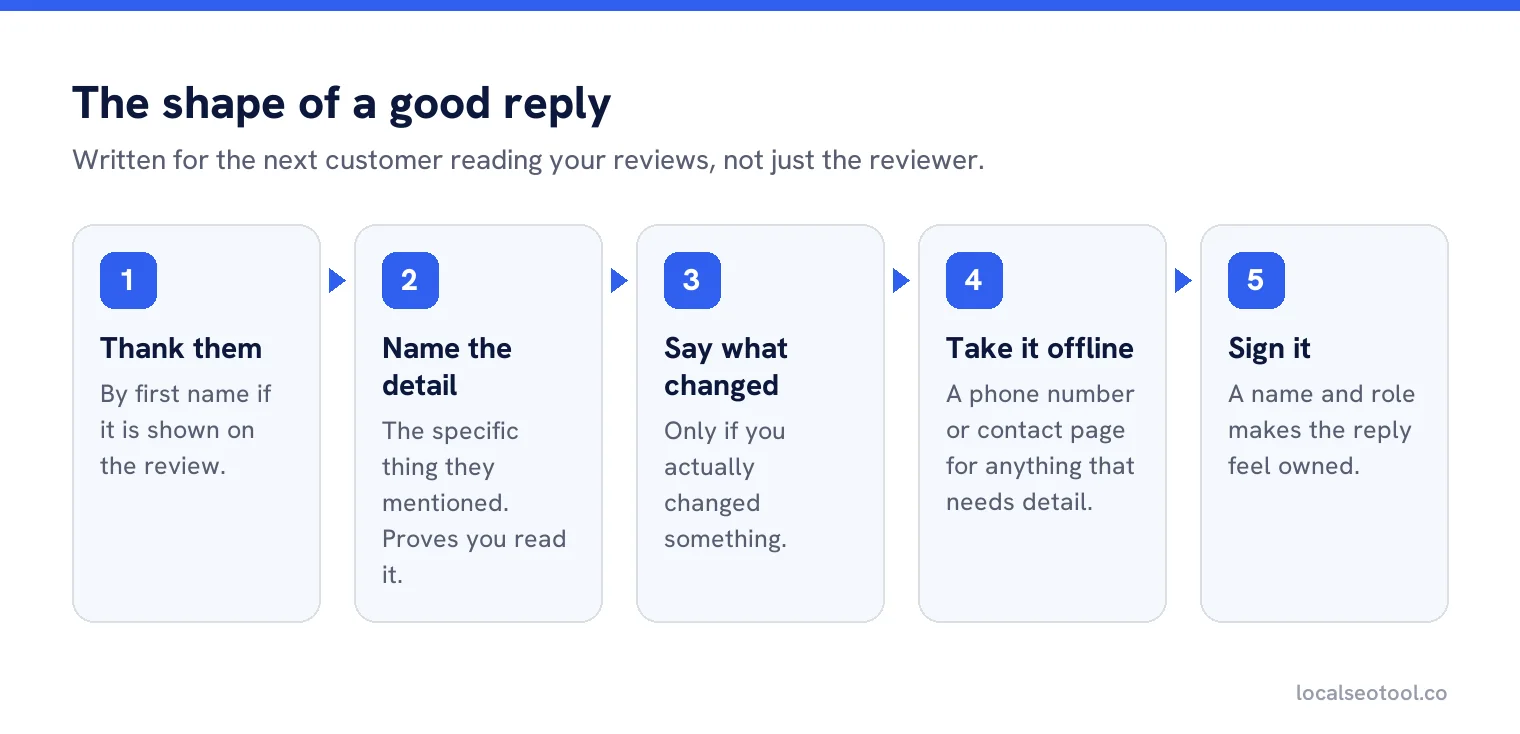
Not every reply needs all five parts. A short thank you under a short five star review is fine. But when a review raises a problem, use the full shape. It shows the next reader that problems get heard and fixed.
Replies to five star reviews
The short five star
Review: “Great service, very quick.”
Reply: “Thanks, Priya. Glad we could get it sorted the same morning. See you next time.”
Use their first name if it’s on the review. Add one small detail if you remember the job. If you don’t, a plain thank you is better than a made-up detail.
The detailed five star
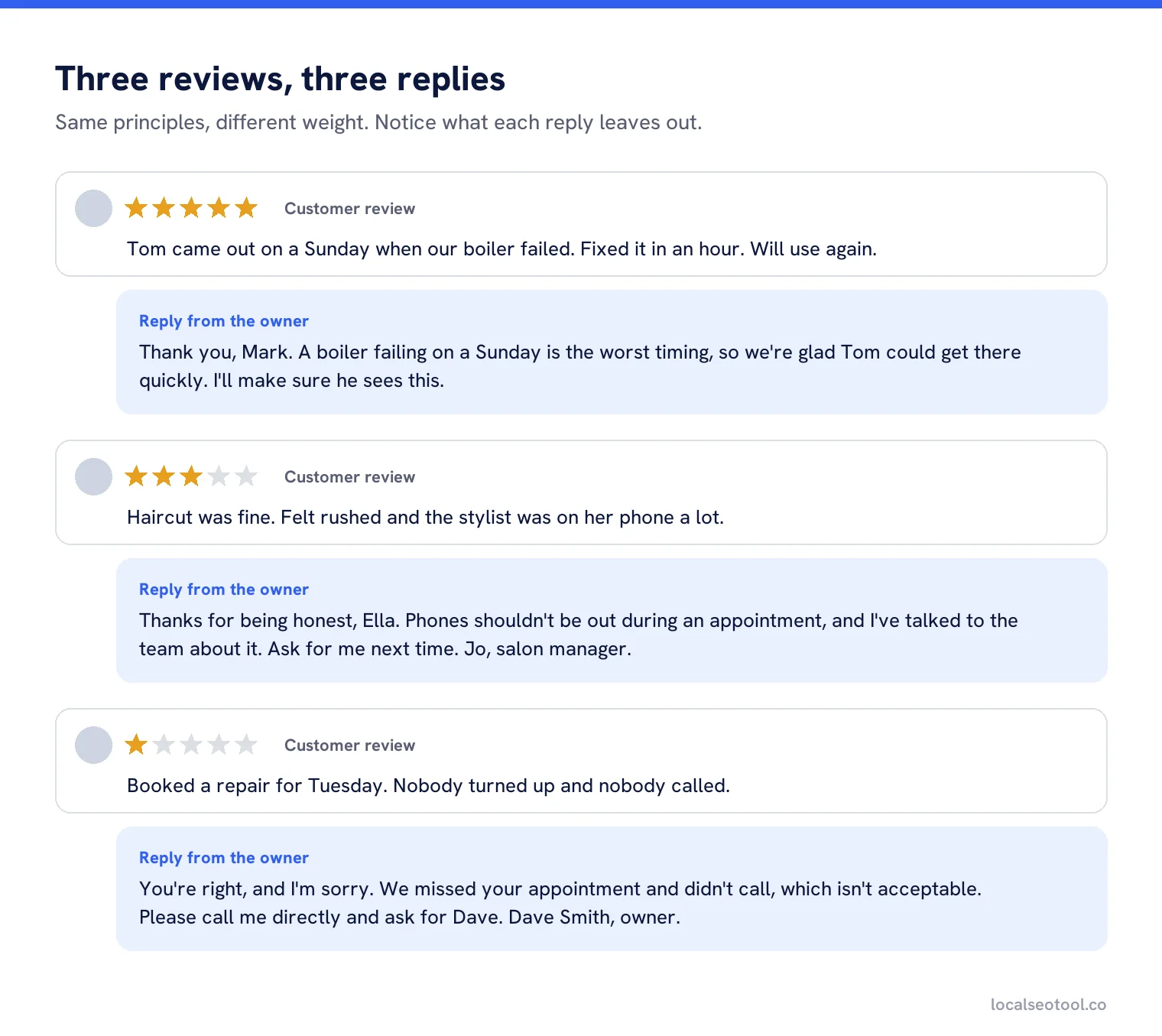
Review: “Tom came out on a Sunday when our boiler failed. Explained everything, fixed it in an hour and didn’t charge a call-out fee. Will use again.”
Reply: “Thank you, Mark. A boiler failing on a Sunday is the worst timing, so we’re glad Tom could get there quickly. I’ll make sure he sees this. Thanks for taking the time to write it.”
When a review names a staff member, mention them back. It tells future readers that real people do the work, and it’s a good thing to pass on to the team.
The five star with no text
Reply: “Thanks for the five stars, James. Much appreciated.”
One line is enough. If time is short, these are the reviews to skip. Spend the time on the ones below four stars instead.
Replies to four and three star reviews
The four star with a “but”
Review: “Food was excellent, but we waited 40 minutes for mains on a Friday.”
Reply: “Thanks, Sarah, and sorry about the wait. Fridays have got busier than we planned for, so we’ve added a second chef on Friday evenings from this week. Glad the food made up for it. Hope to see you again.”
The reader sees a business that listened and changed something. That’s worth more than the missing star. Only say you’ve made a change if you actually have.
The mixed three star
Review: “Haircut was fine. Felt rushed and the stylist was on her phone a lot.”
Reply: “Thanks for being honest, Ella. Phones shouldn’t be out during an appointment, and I’ve talked to the team about it. If you’d like to come back, ask for me and I’ll make sure you have the time you should have had. Jo, salon manager.”
Signing with a name and role makes the reply feel owned. Offering the next visit is fine. Offering a discount or a refund in public isn’t a good idea, because it invites the next unhappy customer to complain in public too.
Replies to one and two star reviews
A real service failure
Review: “Booked a repair for Tuesday. Nobody turned up and nobody called. Took a day off work for nothing.”
Reply: “You’re right, and I’m sorry. We missed your appointment and didn’t call, which isn’t acceptable. I’d like to make this right. Please call me directly on the number on our profile and ask for Dave. Dave Smith, owner.”
When you got it wrong, say so plainly. “You’re right” is the most disarming phrase in a review reply. Notice that the reply offers to make it right, but keeps the actual details for the phone call.
A complaint you disagree with
Review: “Overpriced. Charged me twice what they quoted.”
Reply: “Thanks for the feedback. We always confirm any change to a quote before starting extra work, and I’d like to look at what happened with yours. Please contact us through our website so I can go through the invoice with you.”
Don’t argue the facts in public, even if you’re right. State your normal practice calmly and move the conversation somewhere private. The next reader will make up their own mind, and calm reads better than correct.
Someone who was never a customer
Review: “Terrible. Avoid.” (no record of this person)
Reply: “We can’t find any record of a booking under this name and would like to understand what happened. Please get in touch through our website so we can look into it.”
Then report it. Reviews that aren’t based on a real experience break Google’s content policy. You can report them through Google’s reviews management tool. Our guide on removing a Google review explains which reports usually work.
Special cases
Healthcare, legal and financial businesses
Never confirm that the reviewer was a patient or client, even in a positive reply. “Thanks for your kind words about your treatment” confirms they were treated. In many countries that’s a privacy problem. Write general replies instead.
Reply: “Thank you for taking the time to leave a review. We work hard to make every visit a good one, and we’re always happy to talk directly. Please call the practice if there’s anything you’d like to discuss.”
A review in another language
Reply in the same language if you can do it well. If you can’t, a short reply in your own language is fine. A bad machine translation can read as careless.
A customer who updates their review
Google tells the reviewer when you reply, and they can change their review afterwards. When someone raises their rating after you fixed a problem, a short reply thanking them for coming back is worth posting. It’s one of the strongest signals a future reader can see.
Mistakes that make replies backfire
| Mistake | Why it hurts |
|---|---|
| The same reply under every review | Readers notice quickly. It says nobody actually reads the reviews. |
| Arguing the facts | Even when you’re right, the next reader sees a business that fights customers. |
| Offering money in public | Invites more public complaints from people hoping for the same. |
| Sharing private details | Order numbers, health details, what they bought. Keep it general. |
| Keyword stuffing | “Thanks for choosing the best emergency plumber in Leeds” reads as spam to people. |
| Replying in anger | Wait an hour. Then write it. Then have someone else read it. |
How replies get published
Google checks replies against its content policies before they go live. Its help page on managing customer reviews says replies usually take up to 10 minutes to be reviewed, but can sometimes take up to 30 days. If a reply isn’t approved, you’ll be asked to edit it. Approved replies appear under the review as coming from the business, not from your personal name.
You can edit or delete a reply later from the same place. For the full rules on what gets a reply rejected, see our guide on replying to Google reviews without getting rejected.
Replying at scale
One location with five reviews a week can reply by hand in ten minutes. Twenty locations can’t. The approach that works is to split the reviews by type. Plain positive reviews get a template that rotates wording. Everything else gets a draft that a person edits before posting.
Our template auto-reply handles the first group and leaves anything critical for a person. Our AI review response drafts replies that refer to what the customer actually said, ready for you to add the specifics. For the monthly routine around all of this, see Google review management.
Draft better replies in a fraction of the time
AI drafts that read the review, templates for plain five stars, and one inbox for every location. Three day free trial.
Frequently asked questions
Should I reply to every Google review?
Reply to as many as you can, and always to reviews below four stars or reviews that mention a problem. Five star reviews with no text can get a short thank you or be skipped when time is short.
How do you respond to a negative Google review?
Thank them, acknowledge the specific problem, say what you have done about it, and offer a way to talk privately. Do not argue the facts and do not offer money in public.
How long should a review reply be?
Usually two to four sentences. Long replies to short reviews look defensive. A detailed complaint deserves a slightly longer reply that shows what you changed.
Can I reply to a fake review?
Yes, with a short, calm reply saying you have no record of them and inviting them to get in touch. Then report the review through Google's reviews management tool.
Why is my review reply not showing?
Google checks replies against its policies. It says this usually takes up to 10 minutes but can take up to 30 days. If the reply is not approved, you will be asked to edit it.
Sources
The Google documentation behind the guidance on this page. Google changes these pages without notice, so check the date on any figure before you rely on it.